
P001
Silk Product Families for Private-Label and Contract Programs
We support B2B buyers developing silk pillowcases, bedding, sleep masks, scrunchies, bonnets, and selected accessories for private-label programs. Start with the finished article, then keep fit, component, artwork, pack, and approval questions attached to the correct SKU. A mixed range becomes easier to compare when every item is defined by the job it must perform for the buyer and end user.
Published by China EverBen Silks Reviewed by Mark Liu
Turn a mixed silk range into one comparable brief
Identify the anchor article, SKU quantities, destination, and unresolved buyer decision before quote comparisons begin.

Build a Silk Assortment Around Distinct Product Jobs
A range becomes difficult to source when every item is described only as premium silk. A pillowcase must fit and retain an insert; a fitted sheet must stay on a measured mattress; a mask must block light without unwanted pressure; a scrunchie must hold the intended hair volume; a bonnet must combine crown room with comfortable retention. Begin a multi-product program by defining those jobs separately, then decide which products belong together commercially. This prevents one attractive reference sample from becoming an accidental specification for unrelated items.
Start with the Buying Decision, Not a Product Count
Channel role, use context and explicit exclusions
A range matrix with one row per sellable configuration
Start by asking which what decision the assortment must support: a core bedding launch, a beauty-sleep gift offer, a hair-accessory color story, a hospitality program or another named objective. That answer changes the required breadth. A retailer seeking replenishable essentials may value a narrow set of repeatable sizes and colors, while a seasonal gift program may need fewer sizes but tighter visual coordination across mask, pillowcase and accessory packaging. The product list follows the commercial purpose instead of growing through unrelated catalog additions.
Each proposed item receives a short use statement and a list of exclusions. A pillowcase row can specify the intended pillow dimensions, chosen closure and whether one or both faces contact the sleeper. A mask row can name the geometry and adjustment route without borrowing bonnet fit language. An exclusion is equally valuable: no printed variants in the first launch, no mixed-material reverse, no decorative hardware, or no multipack substitution. These boundaries allow the project team to develop what purchasing actually intends to buy.
A range owner also needs a decision rule for expansion. We recommend adding a new SKU only when it serves a new fit, use, market-positioning or merchandising need that the existing rows cannot satisfy. A color extension can remain a variant; a different closure, layer stack or pack count may require a separate construction row. This distinction keeps assortment growth visible and prevents minor visual changes from multiplying technical files unnecessarily. It also protects forecasting: the buyer can see whether demand is being divided across genuinely different products or merely across colors. When the range is reviewed after launch, sales and return information can be linked back to the exact physical configuration rather than to a broad silk category.
Separate Shared Visual Choices from Product Engineering
Color families may coordinate while constructions remain independent
No specification inheritance across unlike silk products
Color and brand identity can connect a range, but they do not make the products technically interchangeable. The same navy may be viewed on a large flat sheet, a gathered scrunchie and a padded sleep mask; luster, fold direction and surrounding materials make those surfaces appear different. A buyer can build a color plan that acknowledges this visual relationship, then retain independent patterns, layer stacks, elastics, closures and measurement tables. Shared artwork is resized for each geometry instead of being pasted into every dieline at one scale.
This separation also protects fiber and care statements. A silk pillowcase may use a zipper tape that must be described correctly, while a sleep mask may contain a lining, filling and covered elastic. A gift set can coordinate these products without claiming that every hidden component has the same composition. Care is confirmed on each assembled SKU because a zipper, print, filling or elastic can change the appropriate instruction. The collection looks coherent to the customer while remaining truthful and manufacturable behind the scenes.
Turn the Range into Orderable SKU Rows
Variant allocation and selling-unit definition
A complete assortment check before any quotation is compared
Total demand is not enough to plan a mixed silk program. Divide quantity by product, size, fabric-weight reference or material route, color or print, construction and selling-unit pack. A queen zipper pillowcase in ivory is a different orderable row from a king envelope pillowcase in navy; a three-piece scrunchie pack is not interchangeable with three individually packed scrunchies. This allocation exposes low-volume variants, complicated combinations and pack requirements early enough for a buyer to simplify the range deliberately.
Before commercial comparison, we check the matrix for orphan decisions. Every row should have a product identity, finished dimensions, material direction, construction, color or artwork status, quantity, pack format and named open questions. Flag a row that has artwork but no print placement, a fitted sheet without mattress depth, or a mask without an adjustment decision. Closing these gaps produces offers based on the same physical range and avoids a misleading comparison between suppliers who compared different assumptions.
Give Every Silk SKU a Clear Retail and Use Role
A product earns space in a wholesale range by solving a recognizable customer problem or merchandising need. We define that role in language a buyer can check against the physical item. “Core pillowcase for year-round replenishment” leads to different color, closure and pack decisions from “printed pillowcase for a limited gift drop.” “Low-profile travel mask” does not require the same layer volume as a sculpted blackout design. A clear role reduces costly feature accumulation and keeps the sample review anchored to the intended customer experience.
Distinguish Core, Seasonal and Problem-Solving Styles
Replenishment logic versus novelty and specialized use
The assortment role controls development priorities
Core silk products need stable references that can be used again: numeric sizes, retained colors, controlled closure details, durable packaging artwork and clear replacement logic. Seasonal products can accept a shorter visual life but often demand closer artwork timing, color coordination and pack presentation. Problem-solving styles focus on a particular fit or functional concern, such as a mask nose contour or a bonnet crown for long hair. Do not load all three strategies into one SKU, because the priorities compete and make approval difficult.
Once the role is named, we rank features. A core pillowcase may place fit, closure reliability, solid-shade repeatability and care ahead of decorative complexity. A gift accessory may prioritize motif scale, color pairing, opening experience and multipack accuracy. A specialized fitted sheet begins with mattress measurements, pocket depth and elastic behavior. These priorities guide our sample sequence and inspection emphasis; they also help purchasing remove features that increase complexity without improving the product’s job.
Write the Customer Use Situation in Physical Terms
Contact, movement, fit and cleaning behavior
A design brief that does not depend on lifestyle adjectives
We describe how the product is handled: which side touches skin or hair, what it must contain, where it moves, how it is adjusted, what it is fitted around and how often it is likely to be cleaned. Those actions reveal specifications. A sleep mask worn by side sleepers needs attention to edge thickness and hardware position. A pillowcase for a deep, lofty insert needs opening clearance and closure load review. A scrunchie for thick hair needs a different elastic relationship from a slim style intended for fine hair.
This use description also exposes claims that should be narrowed. Silk can provide a smooth contact surface, but a product description should not jump from that observable property to medical or guaranteed beauty outcomes. We state the selected fiber, fabric weight, construction, dimensions and functional design. Where performance such as light blocking, retention or after-care appearance matters, we define the review condition. Buyers receive product language they can defend, while customers receive a promise connected to the object they actually use.
Role definitions should also survive the handoff from product management to sales. We give each SKU a concise set of customer-facing facts—material scope, finished size, construction, intended fit or use, pack contents and care—while holding detailed build decisions in the agreed specification. Sales teams can explain a meaningful difference without inventing benefits. Customer service can identify which product a complaint concerns. Replenishment planners can distinguish a core continuation from a seasonal remake. This shared language is particularly valuable in B2B work, where the person requesting samples may not be the person approving labels or receiving cartons. A stable product role keeps those decisions aligned across the buying organization.
Remove Features That Do Not Support the Chosen Job
Complexity, cost drivers and variant discipline
A final role check on the dressed, worn or packed sample
Feature removal is an important development skill. A reversible face may add value to a color-block concept but create unnecessary bulk in a classic replenishment case. Decorative hardware may strengthen a gift story yet introduce pressure or snag concerns on a sleep product. Extra scrunchie widths may look comprehensive while fragmenting quantities and confusing shelf presentation. The brief should explain what a proposed feature changes in material use, operations, fit, review and pack so the buyer can decide whether it earns its place.
The role is reviewed again with the complete sample in context. Bedding is dressed on the nominated bed components; a pillowcase is filled; a mask is adjusted on more than one face shape; hair accessories are tried on the intended volume; the selling unit is opened and repacked. The review should ask whether the product performs its named job without requiring an explanation from the development team. If the answer depends on an unstated assumption, that assumption becomes a specification or the design is simplified.
Select a Fabric-Weight Route by Finished Construction
Fabric weight is a buyer input rather than a universal quality badge. In a finished silk article it can influence drape, opacity, layer bulk, seam behavior, pressing, packed weight, and handling. Compare alternatives on the actual construction your team intends to buy, then keep the selected route attached to the specific SKU, color, components, and pack discussion.
Read Fabric Weight Through the Finished Article
Drape, density, and load belong to a completed construction
A fabric decision stays separate from fiber, weave, and workmanship
A higher fabric-weight reference reference generally places more silk mass into a given fabric area, but the buyer experiences a finished product rather than a number. On a pillowcase, the difference can affect body, drape around corners and stress near a zipper. On a large sheet, it influences total weight and handling. On a scrunchie, the same increase interacts with gathering ratio and elastic force; on a double-layer bonnet or padded mask, the layer stack may matter more than the face fabric alone. Compare complete constructions, not isolated labels.
We also keep fabric-weight reference separate from fiber identity, weave, filament description, finish and workmanship. “a fabric-weight reference” does not prove a closure is secure, a seam resists slippage, a color is fast or a product will fit. Conversely, a lighter reference is not automatically unsuitable if the geometry, intended use and care route support it. This prevents weight escalation from becoming a substitute for engineering. The specification explains why a chosen cloth belongs in that particular SKU and which other decisions remain independently controlled.
Compare Fabric Routes on Equivalent Product Builds
Swatches set direction; completed samples reveal construction consequences
Change one relevant input at a time
A fair comparison keeps color, finish and construction as consistent as possible while changing the fabric-weight reference. Swatches help the buyer compare luster, hand, opacity and color response, but they cannot show corner fill, edge bulk, gathering, face pressure or elastic interaction. We therefore move the shortlist into finished samples for the products most sensitive to construction. Comments identify the exact cloth and sample so feedback on one weight is not accidentally applied to another.
When the buyer changes fabric-weight reference after a prototype, we reopen the affected work rather than treating it as a material-only substitution. Pattern behavior, seam allowance, needle choice, zipper concealment, gathered fullness, layer thickness, fold dimensions and carton weight may need review. Artwork color can also appear different on a changed base. The brief should communicate those dependencies before the new sample proceeds. This makes the selection deliberate and prevents the bulk product from inheriting dimensions or settings optimized for the earlier fabric.
Bring the Selected Textile Route into the Manufacturing Brief
Material identity and finished-item observation remain connected
A later alternative needs its own comparison
The approved fabric is linked to the SKU through the material record, purchase instruction and production lot. Incoming review checks identity and compares mass, hand, luster, shade and surface with the accepted reference using the agreed method. A buyer should not rely on a roll ticket alone. If a permitted variation is part of the contract, it is written before production rather than invented when a result falls outside expectation. Different colors or finishes are sampled across the allocation because processing can change the way cloth feels and handles.
Bulk inspection then looks at the consequence of the chosen cloth in the product: seam smoothness, panel direction, closure stress, edge shape, gathers, layer symmetry and pack recovery as applicable. A fabric can meet a mass target yet produce an unacceptable sewn result. Keep both levels visible. If an alternative cloth is proposed for replenishment, the buyer receives the comparison and affected sample review instead of discovering the change through a different hand or drape after delivery.
Cost discussion becomes more useful once fabric-weight direction is connected to the complete item. Fabric consumption is only one driver. A denser cloth may alter cutting yield, seam handling, pressing time, fold size, and shipping weight; a lighter route may need another layer or construction adjustment to achieve intended opacity or body. We explain those consequences without publishing a universal commercial value. The procurement lead can choose whether the selected weight supports the product position or whether another construction delivers the desired experience more efficiently. Keep dimensions, colour route, trim, and packaging consistent in each comparison, so unrelated changes do not distort the commercial difference.
State What Is Silk in Every Finished Product
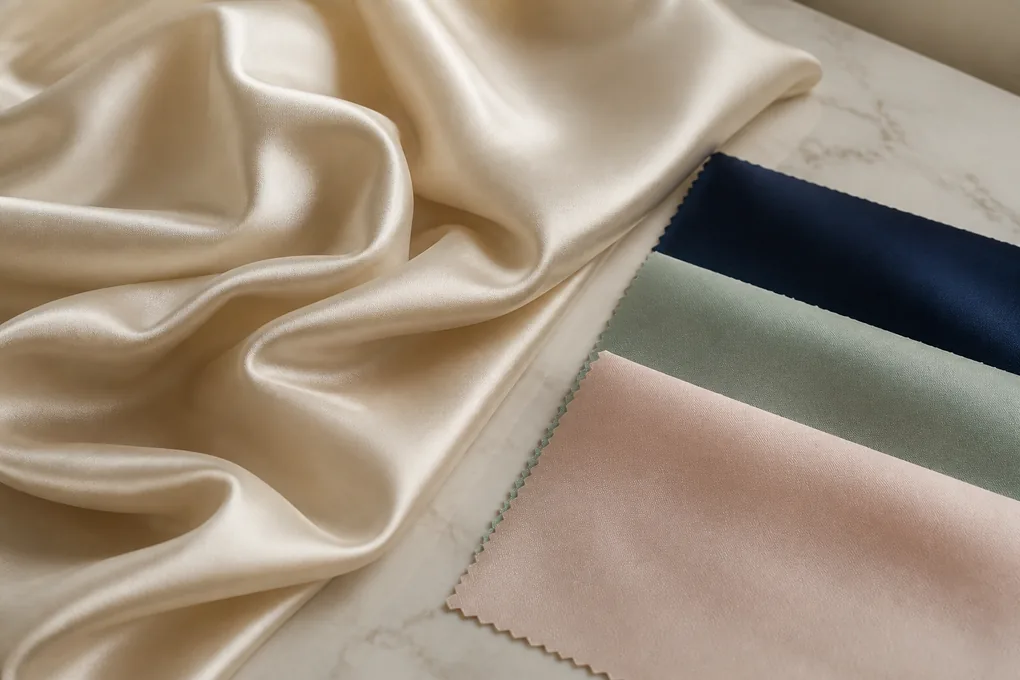
Authenticity concerns damage trust quickly because “silky,” “satin” and “silk” are often blurred in marketplace listings. We treat silk as a fiber statement and charmeuse or satin as a fabric construction description. A finished item may also contain zipper tape, sewing thread, elastic, filling, foam, piping cord, labels or decorative parts. We list those components rather than allowing a 100% silk face to imply that every hidden element has the same composition. Accurate wording helps the buyer label the product correctly and compare offers that might otherwise appear equivalent.
Build a Component Bill of Materials Before Writing Claims
Face, reverse, lining, filling and trims stay visible
Fiber statements follow the assembled product
The component list starts at the customer-contact surface and moves inward. A pillowcase record distinguishes face panels from zipper tape, piping and labels. A mask separates outer shell, skin-contact lining, filling or blackout layer, strap covering, enclosed elastic and hardware. A scrunchie separates the silk tube from its elastic; a bonnet separates outer layer, lining, edge band, tie or slider. This level of detail is not clutter. It prevents the most important material promise from becoming broader than the product that will be shipped.
Mixed constructions receive especially careful wording. The selected range includes reversible concepts as well as silk products combined with another named material. In such a case, the page, sewn label, packaging insert and sales specification must agree about which face contains which fiber. Do not hide a mixed reverse behind the front-face claim or describe a whole accessory as silk when the statement applies only to a cover. The buyer approves the final component language after selecting the physical construction.
Online merchandising should mirror this component discipline. Product titles can lead with the main silk contact surface, but detail tables should clarify mixed parts before a buyer needs to ask. Images can show the face, reverse, closure, lining and adjustment system in clear product terms. The same component names should appear in RFQs, labels and customer-service references. If the construction changes—for example, a different lining, filling or elastic—the public wording is reviewed again. This closes a common gap between a sample approved by a product manager and copy assembled later by a marketing team from an older style. Truthful specificity strengthens the silk claim instead of weakening it.
Keep Weave, Grade and Documented scope Language Separate
One term cannot prove another
Claims require their own supporting records
Satin and charmeuse describe how a surface is built and viewed; they do not identify the fiber by themselves. Fabric-Weight Reference describes a fabric-weight reference; it does not establish fiber origin or workmanship. A filament grade statement is also different from a finished-product test. Keep these terms in separate fields so a product description cannot assemble them into an unsupported chain of quality conclusions. This is particularly important when comparing a smooth synthetic satin item with a silk fabric that may share a similar photograph.
Documented scope references receive the same discipline. A supporting document can be mentioned only when it is current, its holder and validity are checked, and its scope covers the exact material or product route being offered. One document is not used to certify an entire catalog by association. We also avoid turning a harmful-substance documented scope into an organic, medical or environmental claim it does not establish. Where a buyer needs a particular compliance statement, that requirement enters the RFQ for documentary review before public copy is approved.
Maintain Traceability from Fabric Lot to Sewn Label
Identity through cutting, assembly and packing
A finished claim that can be investigated later
Material identity follows the order through incoming rolls, cut bundles, sewing and packed lots. Color, fabric-weight reference route and component code are linked to the SKU and production record. Labels are released from the final BOM rather than copied from a similar item. When multiple products share a color or outer cloth, their hidden components remain distinguishable. This avoids a common error in gift sets: repeating one fiber statement across a mask, scrunchie and pillowcase even though their construction layers differ.
Traceability supports both receiving and problem investigation. If a buyer questions a component or surface, the lot and SKU records should identify what was used and which instruction was current. Retained references and supporting documents provide a starting point for review. No party should promise a laboratory result that has not been completed, but we can agree the evidence and sampling route in advance. That gives purchasing a practical way to verify a material claim rather than depending on commercial value, sheen or a burn-check anecdote.
Connect Weaving, Color, Cutting and Sewing Decisions
Silk product quality is created through linked operations. Fabric width affects panel joins; dyeing or printing affects shade, hand and face direction; pattern geometry determines fit and load; needle and seam choices determine whether fine woven silk puckers or slips; finishing and packing can preserve or mark the surface. We manage the handoffs between these steps so a late change does not remain trapped in one department. A beautiful development sample is useful only when its material, pattern, construction and finishing route can be described clearly enough to reproduce.
Prepare Fabric for the Product That Will Be Cut
Usable width, face direction and lot planning
Construction begins before the sewing line
Material planning considers the usable fabric width, the dimensions of the largest panels, the selected face and grain direction, and the allocation by color or print. A large bedding piece may require a disclosed join or a different panel plan, while a narrow accessory may need controlled motif orientation or gathering. We mark the intended face before spreading because mixed directions can create obvious luster differences. Roll inspection also identifies defects and shade variation before they are distributed into finished units.
Dye lots and print batches are allocated around the selling configuration. Pieces that must appear together, such as bedding components or a coordinated gift set, receive a shade strategy before cutting. We do not assume that one named color looks identical on every product geometry. Thread, zipper, elastic covering and piping can also alter the visual result. The cutting plan preserves approved pairings and lot identity so assembly teams do not create a mixed set that only becomes visible after packing.
Translate Fit and Function into Pattern and Operations
Measuring points, seam paths and reinforcement
Operator instructions that show the reason for control
Patterns carry finished measuring points, allowance, orientation, notches and component placement. The important geometry differs by product: pillowcase inside size and opening, fitted-sheet pocket and corner, mask nose curve and strap anchor, scrunchie strip and elastic relationship, or bonnet crown and edge band. We identify where load concentrates and where a seam remains in contact with skin or hair. This information guides seam choice and handling more effectively than a generic instruction to use high quality stitching.
Operation sheets identify critical joins, closures and attachments in the order they are made. Fine woven silk requires control of needle damage, puckering, skipped stitches, seam grin and yarn slippage. Elastic and hardware introduce separate attachment risks. The desired appearance should be established on a construction sample, then check that the BOM, pattern and operation notes describe the same build. If a method changes the visible hand or shape, the buyer reviews the result instead of receiving an unexplained factory substitution.
Equipment settings and operator technique are confirmed on the chosen material rather than copied from a heavier woven textile. Fine silk can show feed imbalance, needle holes, tension marks and pressing shine quickly. A development review can use trial pieces and first-off units to establish a clean result at the critical seams, curves and attachments. Handling surfaces are kept suitable for a light-colored, high-luster face, and work-in-progress is protected from hard components and contamination. These practical controls do not require exaggerated factory claims. They demonstrate how the approved specification is translated into repeatable workmanship and where an inspector should look before a small process drift becomes visible across an order.
Reconcile the Complete Product Before Bulk Release
BOM, drawing, artwork, sample and pack in one review
Changes reach every affected process
The pre-production review places the current BOM, measurement chart, construction drawing, color or artwork reference, label files, packaging instruction and identified sample together. Look for conflicts: a changed closure that is missing from the pattern, a new fabric-weight reference that was not considered in fold dimensions, a revised print that still uses the old cutting orientation, or a pack count that differs from the barcode. Closing these conflicts is more efficient than correcting completed goods or debating which file was authoritative.
After release, a change is evaluated by consequence. New dimensions may affect consumption and carton size; a new fabric may require another sewing or care review; a new decoration may introduce a contact or packing issue. Revised files are issued as a group and superseded versions are withdrawn. Inline checks are positioned after the operations most capable of changing the approved result. This chain gives the buyer a repeatable product rather than a one-off sample that depended on unrecorded craftsmanship.
Plan Solid Colors and Printed Silk Without Guesswork
Silk color is affected by luster, viewing direction, fabric weight, dye or print route and surrounding components. Printed designs add repeat, scale, orientation, registration and cutting placement. Develop solid and printed programs through different approval paths even when they share a palette. A color name is useful for merchandising but not sufficient for production. Artwork displayed on a flat screen is likewise incomplete until it has been reviewed on the chosen cloth and sewn into the intended product geometry.
Develop Solid Shades Under Agreed Viewing Conditions
Lab dips, light source and trim coordination
Color decisions that survive scale and direction
A solid-color brief begins with a physical or instrument-linked target and the illumination under which it will be judged. Silk’s reflective face can appear lighter or darker when turned, so panel direction is controlled during cutting and evaluation. Compare the proposed shade on the selected fabric-weight reference and finish rather than transferring approval from an unrelated cloth. Light and dark colors may require different attention to opacity, rub behavior, stains and packaging transfer. The buyer approves the actual material route planned for the sample.
Matching includes components the customer sees: sewing thread, zipper tape, piping, elastic covering, ties, labels and packaging accents. Exact visual sameness is not always physically realistic across different materials, so we identify whether the intent is a close match, tonal coordination or contrast. For sets, we establish whether pieces should come from a common lot or controlled shade group. Replenishment compares the new lot with retained standards rather than accepting a familiar color name as proof of continuity.
Engineer Artwork for the Finished Product Shape
Repeat, orientation, safe zone and seam interruption
A strike-off is not a sewn-product approval
The print brief identifies the controlled artwork file, scale, repeat dimensions, direction, color targets and intended placement. Product geometry changes the design: a pillowcase has a front orientation and closure zone; a scrunchie compresses the motif into gathers; a bonnet curves across panels; a mask can cut through important elements at the nose or edge. We overlay the construction on the artwork so the buyer can see likely seams, folds and interruptions before fabric is printed.
A strike-off answers questions about color, detail, registration, hand and the interaction with the chosen silk ground. It does not prove that motifs land correctly after cutting or that the closure avoids the focal element. We therefore progress to a finished prototype. Comments distinguish color approval from placement and construction approval. If the artwork or scale changes, the affected stage is repeated. This preserves creative intent without allowing an earlier approval to cover a visibly different result.
Control Bulk Color and Print Across Variants
Lot grouping, panel orientation and finished inspection
The pack image matches what the customer opens
Production allocation accounts for size, product shape and pack grouping. Solid set components are compared together; printed panels are checked for direction, repeat, registration and placement rules. If placement is random, that fact is explicit and the acceptable appearance is still defined. If placement is engineered, cutting markers and bundle identity preserve it. Examine print hand and surface because excessive processing can change the drape or smoothness the buyer selected in the base cloth.
Final inspection views the product both flat and in its use or packed condition. A motif may look aligned on an empty case but shift after filling; a printed scrunchie must be judged relaxed and stretched; a folded package may hide the design the online image presents. We check shade, stains, unprinted areas, face direction, panel mismatch and pack assortment across the relevant lots. These observations give buyers useful color control without promising impossible visual uniformity under every light.
Color approval also needs a rule for customer photography and digital screens. A physical silk shade cannot look identical on every display or under every light, so we avoid promising screen-perfect color. The buyer selects the authoritative reference and decides how product photography will communicate variation responsibly. For printed work, the controlled file remains the design reference, while the strike-off and sewn sample show how that design appears on the actual cloth. Packaging and online images are compared with the approved product to prevent a dramatic editing treatment from creating an expectation the shipped shade cannot meet. This protects conversion quality as well as production accuracy.
Approve Materials, Prototypes and Packaging in Stages
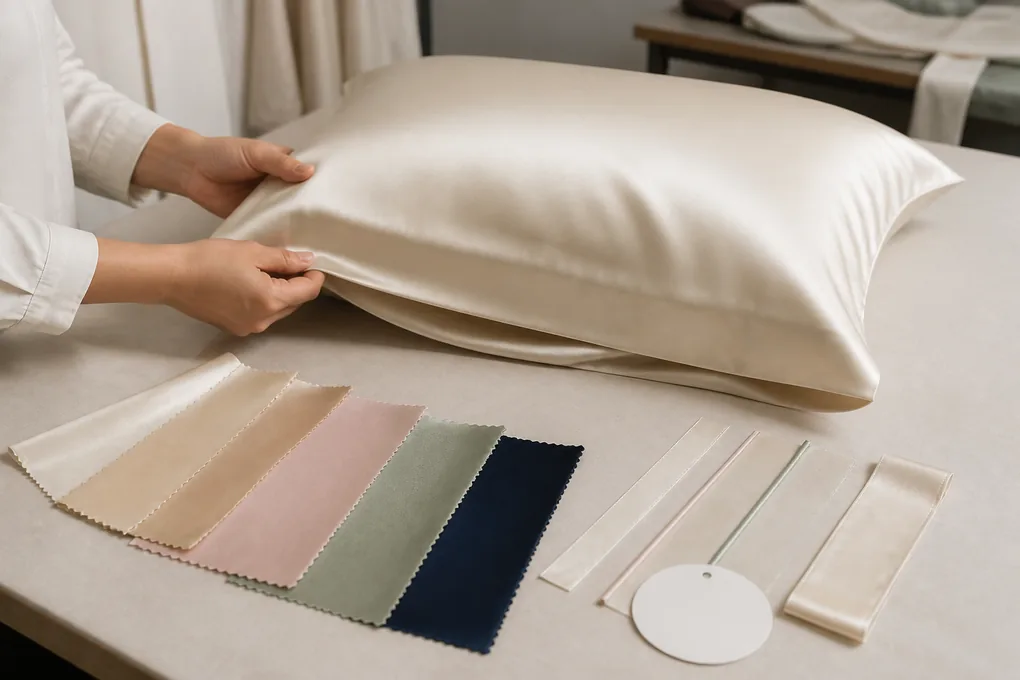
One sample cannot prove an entire silk program. A fabric swatch can establish direction for hand and luster but cannot show fit. A lab dip or strike-off can settle color yet leave construction open. A prototype can confirm shape while using temporary packaging. A pre-production sample can bring approved materials, trims, artwork, labels and pack together. The buyer should know what each submission is intended to decide, then record approved, rejected and still-open points separately. This reduces repeated sampling caused by comments that mix unrelated stages.
Use Material References for Material Questions
Hand, luster, fabric-weight reference direction and color ground
No fit approval from a loose swatch
Early material references allow comparison of fabric-weight options where the catalog supports them, along with surface direction, opacity, drape and base color. Identify the reference and product family so a fabric accepted for a pillowcase is not automatically assigned to a padded mask or double-layer bonnet. Where a fiber, grade or supporting document statement is required, the documentary question is reviewed alongside the physical swatch instead of inferred from touch or shine.
The buyer’s material comment should say what is accepted: color direction, hand, luster, weight route or another named characteristic. Construction remains open until the cloth is cut and sewn. If the final process changes the surface, such as printing, washing or additional finishing, the relevant material impression is reviewed again on the processed fabric. This narrow approval language prevents a positive reaction to softness from being interpreted as consent to dimensions, closure, elastic, labeling and pack.
Sample logistics are planned so comparison remains meaningful. Each submission carries a product ID, material route, color or artwork revision, size, construction and date. When several alternatives travel together, they are labeled independently and the comment form uses the same identifiers. We ask reviewers to evaluate samples under suitable light and with the intended insert, mattress, face or hair context available. Unidentified photographs sent through messaging apps can supplement comments but do not replace the returned or retained reference. This discipline prevents the team from applying feedback to the wrong version, a frequent cause of unnecessary remake cycles and contradictory approvals in complex private-label programs. A decision deadline and responsible reviewer are recorded so unresolved comments do not remain hidden between sample rounds.
Build Prototypes Around the Highest Product Risk
Fit, closure, adjustment and component interaction
Corrections identify cause and desired result
The first sewn sample targets the feature most likely to fail. A pillowcase is filled with the nominated insert; a fitted sheet is installed on the measured bed height; a mask is assessed for nose leakage, eye clearance and strap stability; a scrunchie is evaluated for wraps and recovery; a bonnet is loaded with the intended hair volume. Temporary colors can sometimes be acceptable if color is not the question, but the substitution is declared so no one treats it as a final appearance sample.
Useful comments name the observed problem, its location, the relevant condition and the requested result. “Too small” becomes a named measuring point or fit observation; “strap uncomfortable” identifies head range, adjustment and pressure zone; “print wrong” distinguishes hue, scale, registration and placement. We respond with the proposed correction and any consequence for another feature. The next sample is checked against that specific change while previously accepted characteristics are reviewed for unintended movement.
Approve the Selling Unit Before Calling the SKU Ready
Pre-production assembly of product, labels and pack
A control set for inline and final comparison
The pre-production sample uses the selected fabric, color or print, trims, dimensions and construction, then enters the intended selling-unit pack. Labels and inserts are reviewed for fiber, care, size, color, origin and responsible-company wording appropriate to the target market. The barcode and product identity must match the physical contents. Packing is assessed for folds, hardware pressure, scuffing, transfer, presentation and the customer’s ability to remove and repack the item.
Approval produces a controlled set: identified physical sample, BOM, measurement chart, construction drawing, color or artwork reference, label files, pack instruction and comment history. Inline and final inspection use those references according to the product risk. Approval is not inherited by unreviewed sizes, colors, prints or constructions. When a later reorder changes a material or process, we identify which approvals remain useful and which must be refreshed, preserving speed without pretending the product is unchanged.
Turn Consumer Complaints into Bulk Inspection Points
Retail complaints are useful when translated into physical causes. “Not real silk” calls for component-level fiber evidence and accurate labels. “Pillowcase slid off” points to insert fit and closure. “Sheet came loose” points to mattress height, pocket and elastic. “Mask leaked light” points to nose contour, edge seal and strap position. “Scrunchie stretched out” points to elastic force, joint and recovery. “Bonnet fell off or hurt” points to crown, band and adjustment. We build inspection around these product-specific risks instead of using one generic workmanship checklist.
Define Observable Defects Before Production
Location, condition and reference make a finding useful
No new tolerance invented after goods exist
A defect description states what is observed and where: seam opening beside a zipper stop, light gap along the lower mask edge, fitted-sheet corner not seated on the nominated mattress, scrunchie elastic failing to recover, or bonnet tie pulling at its attachment. The condition matters. Some problems appear only after filling, stretching, adjusting, laundering or packing. We agree the relevant method and acceptance approach during development so final inspection does not create a new rule in response to a disappointing result.
Measurements receive named points, units, product condition and agreed tolerance. Appearance controls use an identified shade, artwork or workmanship sample under appropriate viewing conditions. Function checks specify the reference object or fit range. Documentary requirements identify the file and version. This preparation gives inspectors something stronger than “good quality” and gives suppliers a fair opportunity to build the requirement. It also helps purchasing decide whether a finding is isolated, systematic or caused by an incomplete instruction.
Place Checks Where the Failure Can Still Be Corrected
Incoming, inline, final and packed-product controls
Inspection follows the process risk
Incoming review considers fabric identity, shade, face, obvious defects and relevant components before quantities are cut. Inline checks occur after operations that create irreversible risk: large-panel joining, zipper installation, elastic joining, strap attachment, artwork cutting or crown assembly. Final product inspection covers identity, dimensions, workmanship, function and appearance. Packed review adds labels, barcode, selling-unit count, assortment, fold condition and carton marks. The sequence catches a problem near its cause instead of waiting until every item is sealed.
The emphasis changes by product. Pillowcases concentrate on contact-face quality, fit, closure and seams. Bedding adds large-panel dimensions, pocket or duvet functions and set matching. Masks add symmetry, layer distribution, leakage and adjustment. Scrunchies add width, gathers, hold and recovery. Bonnets add coverage, retention, edge comfort and ties. We can use a shared reporting framework, but the checkpoints themselves remain physical and specific. This avoids declaring a range acceptable because all labels were present while its main use feature was never challenged.
Inspection planning should also consider how defects cluster. Shade issues may follow a material lot; wrong dimensions may follow a pattern or size marker; seam damage may follow one operation; mixed packs may follow a packing shift. Sampling across those boundaries produces more information than taking all units from one convenient carton. Map the order structure before selecting inspection units and preserve identifiers in the report. When a problem is found, targeted additional checks can check whether it is local or widespread. The buyer receives a clearer commercial picture, and corrective work can focus on the responsible process without disturbing goods that remain consistent with the approved reference.
Report Findings for Commercial Decisions
Variant distribution, quantity and likely process source
Corrective action that protects accepted features
Inspection samples should reach different lots, colors, sizes and pack configurations according to the order structure. A finding identifies the affected unit and location, the comparison reference and how many similar observations were found. Photographs support the record but do not replace measurements or a clear description. Where the issue appears linked to a process stage, that connection is noted as an investigation lead rather than asserted without review. Buyers can then judge severity, spread and the need for correction or additional sampling.
A correction is evaluated for side effects. Increasing strap tension may reduce slippage but create pressure; deepening an envelope overlap may improve retention but make insertion difficult; tightening fitted-sheet elastic may load corners; changing needle or stitch can alter puckering. We check the new result against the original complaint and previously accepted features. This prevents a fast fix from moving the customer problem elsewhere. The final report shows the disposition and the reference that production must follow for remaining goods or future replenishment.
Coordinate Bedding and Hair Accessories Without Shared Specs
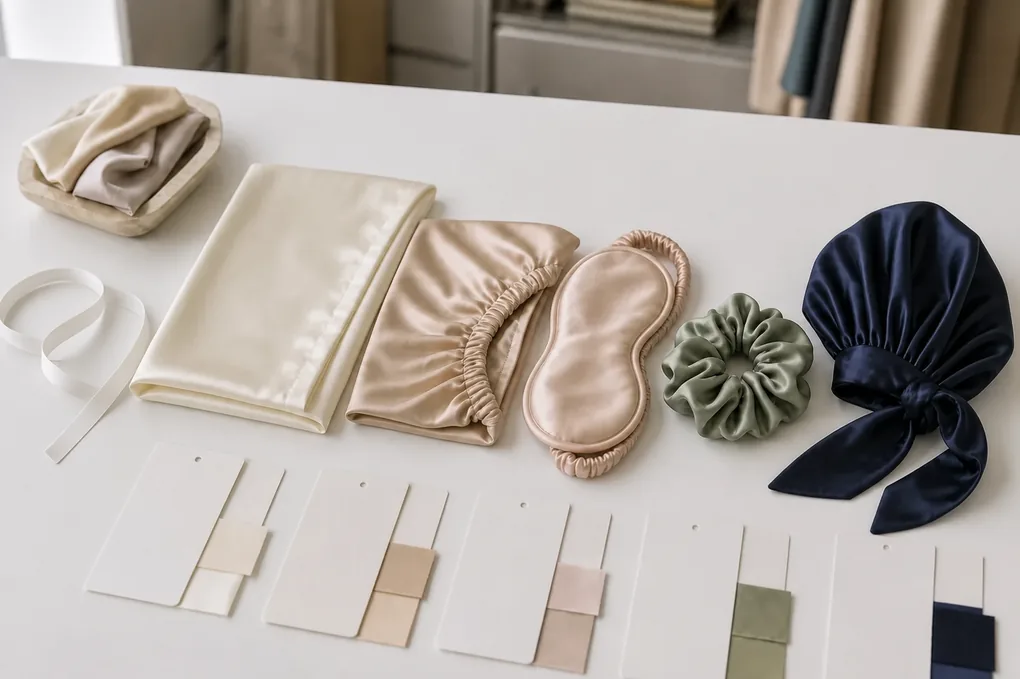
A coordinated silk collection can use one palette and brand story while respecting the different engineering behind bedding, sleep and hair products. Large panels depend on fabric width and dimensional stability; masks depend on face geometry and layers; scrunchies depend on gathering and elastic; bonnets depend on crown volume and retention. We coordinate what the customer sees—color relationships, artwork language, packaging hierarchy and set composition—without copying the same material statement, tolerance, care instruction or approval sample into every SKU.
Create a Parent Assortment with Child Specifications
One commercial family, many physical constructions
Every orderable item keeps its own technical identity
The parent assortment records the launch name, shared palette, artwork family, sales channel, destination and high-level allocation. Beneath it, each child SKU carries product-specific dimensions, materials, construction, components, quantity and pack. This structure makes coordinated decisions efficient without hiding technical differences. A buyer can update the shared color direction once, then review how that update should be executed on a pillowcase, gathered accessory and padded mask rather than assuming one dye or print instruction fits all.
Component fiber statements remain tied to the child product. A silk scrunchie contains elastic; a mask may include filling and hardware; a reversible case may have two different faces. Their labels and online descriptions must reflect those facts even inside a gift set. The same principle applies to care. We seek a coherent customer experience, but we validate cleaning on the complete construction. If the brand wants one simplified care message, the products must first be shown to support it rather than being forced under convenient wording.
Coordinate Color and Artwork Across Different Geometries
Scale, luster and placement change by product
A family review alongside individual approvals
A shared color is reviewed as a relationship, not a promise of identical appearance on every shape. Large flat bedding shows shade and direction differently from tightly gathered silk; a mask’s layers can change opacity; piping or elastic covering may require another material. We define which products should closely match, which may be tonal and which intentionally contrast. Dye-lot and shade-group decisions follow the pack and set plan so products displayed together receive the necessary coordination.
Artwork is adapted rather than mechanically resized. A motif that fills a pillowcase panel may need a smaller repeat on a scrunchie, deliberate framing on a mask and panel-aware placement on a bonnet. The buyer reviews both individual samples and a collection presentation. Individual review protects function and construction; the group view tests color balance, scale and merchandising. A product is not approved technically merely because it looks attractive beside the others, and a technically correct product can still be revised if it disrupts the intended range story.
Build Gift and Multipack Contents Without Ambiguity
Component count, substitution and barcode hierarchy
The opened set agrees with the offer
A gift set receives a component BOM naming every product, size, color or print, construction and quantity. Substitution rules are explicit; “assorted” is not used when the online image or retailer agreement promises a particular sequence. Parent and child barcodes are mapped so warehouse and customer service teams can identify the full set and its pieces. Inserts describe material components accurately rather than applying one blanket silk phrase to mixed constructions.
Approve the real pack with finished products inside. The review checks fold or placement, hardware contact, color arrangement, count, labels, barcode, opening order and recovery after storage or transit conditioning. A set-level golden sample accompanies the individual product controls. Final inspection opens packs across the production run to confirm contents and presentation. This approach prevents a single wrong color, missing accessory or inaccurate insert from turning several acceptable products into one unacceptable selling unit.
Collection planning benefits from a “shared versus local” decision table. Shared fields can include palette name, artwork family, brand tone, destination and launch date. Local fields include product dimensions, component fibers, fabric-weight reference selection, closure, layer stack, elastic, fit range, care validation and inspection method. Packaging may contain both: a common visual system with product-specific dielines and labels. Keeping these two levels explicit makes future edits safer. A new logo can flow across the collection, while a change to mask filling or fitted-sheet pocket depth reaches only the affected SKUs. The buyer gains brand consistency without creating a single oversized specification that no factory team can follow accurately.
Protect Silk Presentation from Packing Discussion to Shelf
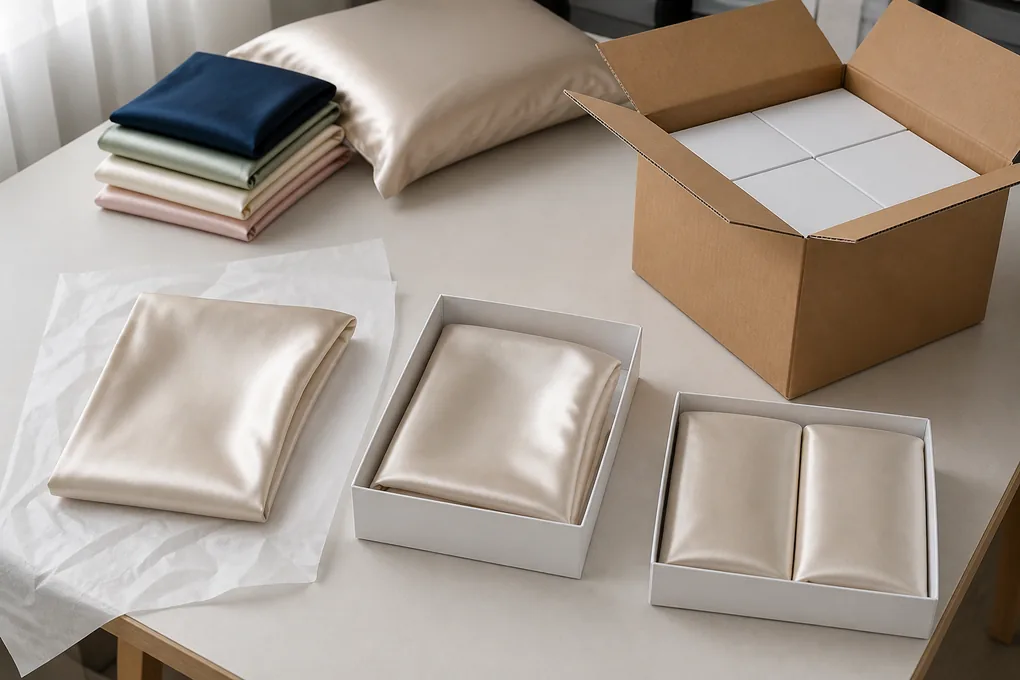
Silk can reach final inspection in good condition and still arrive with hard creases, scuffs, dye transfer, crushed gathers or hardware impressions if packing is treated as an afterthought. We design the selling unit around the finished object. The fold sequence, protective layer, pouch or box, insert, barcode and size or color identification must preserve the surface and help a customer understand what was purchased. Packaging is reviewed with the real product inside, because empty mockups cannot reveal pressure, movement or recovery.
Choose a Fold That Respects Surface and Construction
Face protection, hardware isolation and recovery
The product controls the package dimensions
Large pillowcases and bedding need smooth folds that fit the selling unit without excessive compression. Zippers, sliders, buckles, clips and ties are positioned or protected so they do not press into a visible silk face. Gathered scrunchies and bonnet crowns need enough room to recover their intended volume. Padded masks should not be flattened in a way that shifts filling or deforms edges. We trial the fold on a production-representative item and reopen it after conditioning to judge marks and shape.
Pack dimensions follow that successful trial rather than a generic box target. If reducing cube introduces permanent creases, distorts a flange or compresses an accessory, the buyer can compare the saving with the presentation cost. Tissue, sleeves, pouches, paper bands or formed supports are chosen for a specific protection job. Any claim about material recyclability or environmental benefit requires its own evidence; we do not add broad sustainability wording simply because a package uses paper.
Packaging storage conditions deserve attention before components arrive in volume. Paper, ink, adhesive, tissue and plastic elements can behave differently under humidity, pressure and long contact with dark or light silk. Review whether ink rubs, adhesive migrates, tissue transfers color or a pouch traps an odor. Finished packaging is stored cleanly and separated by version so obsolete labels do not re-enter use. The packing area follows the product sequence and uses visual references for variants that are difficult to distinguish when folded. These controls protect the customer-facing surface and reduce the likelihood that packaging materials, rather than the silk construction, become the source of a return. First-off packed units are checked before the line continues, which catches an incorrect fold or insert while correction is still inexpensive.
Make Labels and Inserts Useful at Receiving and Opening
Identity, care and component wording
Artwork is controlled like product artwork
The outside of the selling unit identifies the SKU, product, size, color or print, piece count and barcode required by the channel. The sewn label and insert carry approved fiber, origin, responsible-company and care information for the destination. Mixed products or sets retain component-level accuracy. Instructions for adjustable masks or tie bonnets show operation clearly without promising a universal fit. Keep marketing copy distinct from mandatory disclosures so decorative language does not obscure or contradict them.
Every printed packaging element has a version, substrate, dimensions, color expectation and placement. We check readability at actual size, scan the barcode on the assembled pack and confirm that the image represents the contents. An old render is withdrawn after artwork revision. Where one package serves multiple variants, the variable identifier must be legible and securely applied. These controls reduce wrong-item shipment and customer confusion while making reorders easier to compare with the approved presentation.
Check the Selling Unit Through Handling and Repacking
Scuffing, transfer, movement and count
Packed-product approval before carton planning
We condition and handle the complete selling unit in a way proportionate to its route. The review looks for surface abrasion, color transfer, snagging, loose components, crushed shapes, label movement and difficulty removing the product. The customer’s first view should match the intended presentation without requiring steaming or reshaping beyond reasonable product care. If the item is expected to be opened by retail staff and returned to display, repacking steps are tested as well.
Final packed inspection verifies product identity, quantity, color or print, size, component labels, insert, barcode and visible condition. For multipacks and gift sets, the order of pieces is checked against a visual BOM. Results are sampled across the run because packing drift often appears after material replenishment or shift change. Only after the selling unit is stable do we finalize inner packs and master cartons. This prevents shipping efficiency from being achieved by damaging the customer-facing product.
Keep Multi-SKU Cartons Countable at Receiving
Bulk silk orders often contain many small variant allocations: multiple pillowcase sizes and closures, bedding components, mask shapes, scrunchie colors and bonnet constructions. Warehouse errors become likely when carton planning starts from total units rather than orderable SKUs. We design the shipping structure from the selling unit outward. Inner packs, master-carton assortment and marks must let the buyer count, identify and route goods without opening every package or relying on a color name that is hard to distinguish under warehouse light.
Build Cartons from the Variant Allocation
One carton plan for known SKU rows
No hidden mixed assortment
The packing list begins with the same SKU matrix used for quotation. We decide whether a carton contains one SKU or a controlled assortment and state the exact quantities. If mixed cartons are necessary, inner groups and separators maintain identity. Size, shade, print, construction and pack count remain visible in the code. We avoid unapproved substitutions designed merely to fill carton space, because they move the commercial problem to receiving and can break retailer allocations.
Carton space is confirmed with the approved selling units. Silk products vary in cube: bedding is broad and fold-sensitive; boxes add rigidity; gathered accessories may compress; masks or bonnets can deform. Compare product protection, carton weight, handling and space rather than using a universal piece count. Empty space is controlled so packs do not move and scuff, while excessive pressure is avoided. The agreed configuration becomes part of the shipment instruction and carton data record.
Write Marks for People Who Must Receive the Goods
Product identity, quantity and destination logic
Readable information without exposing unnecessary detail
Carton marks identify the purchase order or reference, SKU or assortment code, product description, color/size where required, quantity and carton sequence according to the buyer’s receiving rules. Gross weight, net weight and dimensions are recorded from the production-representative pack when contractually needed. Align marks with commercial documents and barcode hierarchy so warehouse scans and human reading point to the same contents. Supplier shorthand is not used when the buyer cannot decode it.
Label placement considers pallet stacking and handling. Marks should remain visible, attached and legible without requiring cartons to be turned repeatedly. When privacy or channel rules restrict information, we design a code that still supports traceability. Corrections are controlled; handwritten changes or overlapping labels can cause routing mistakes. The buyer reviews a carton-mark proof and, where useful, a packed-carton photograph before release. This simple step prevents correct products from becoming unidentifiable inventory.
Receiving efficiency improves when the buyer confirms how cartons will be broken down. An e-commerce warehouse may need single-SKU cartons that move directly to pick locations; a distributor may prefer controlled mixed cartons for regional allocation; a retail program may require inner packs by store quantity. Those structures can be modelled once the selling-unit dimensions and variant demand are known. The decision affects labels, dividers, count checks and pallet use, so it belongs before final packing artwork. A carton scheme built around the actual warehouse process reduces rehandling and mispicks without forcing every order into the same logistics pattern. The approved structure is reflected in the packing list and receiving instructions, preventing a warehouse from interpreting a mixed carton differently from the factory.
Open Representative Cartons Before Shipment Release
Count, condition and documentation parity
Receiving problems found while they are still local
Packed verification checks carton identity, selling-unit count, assortment, barcode, marks, inner protection and visible condition after opening. Select cartons across the run and include mixed configurations if they exist. The findings are reconciled with the packing list and order allocation. A carton may have the right total count but the wrong color sequence or size balance; both levels are checked. We also look for pressure marks, crushed boxes, moisture exposure and movement that were not visible at the selling-unit stage.
Shipment records preserve the relationship among production lot, SKU allocation and carton sequence. This helps the buyer receive efficiently and gives both parties a path for investigating a discrepancy. We do not claim a transit result that has not been tested or observed, but we can agree packaging trials and acceptance evidence appropriate to the route. Accurate carton data also improves future replenishment planning because actual cube, weight and pack performance replace early estimates.
Send an RFQ That Can Be Quoted Without Hidden Assumptions
The fascheck RFQ is not the shorcheck email; it is the brief that prevents suppliers from comparing different products. We need to know which silk items are required, how they will be used, the numeric dimensions, selected or requested material direction, construction, variants and allocated quantities. Custom color or artwork, selling-unit packaging, destination, target decision date and approval expectations complete the commercial picture. Unknowns are acceptable when they are visible. A discussion can compare options, but an unanswered question should not be silently converted into a promise, commercial basis or delivery assumption.
Describe the Product Before Asking for the Commercial Answer
Identity, use, measurements and construction
The offer refers to one physical configuration
Start with one row per orderable item. Name the product and intended market, then provide finished dimensions or the physical reference it must fit: pillow insert, mattress and topper, duvet, face range, hair volume or another relevant object. Identify the desired closure, layers, adjustment, elastic relationship or edge style. If a fabric-weight route is being considered, state whether one is mandatory or whether a comparison is requested. This gives us a product we can analyze rather than a category label.
Material and claim requirements follow at component level. Tell us whether the silk statement applies to one face, both faces, a lining or a cover, and disclose any mixed-material concept. List required documented scopes or tests as documentary deliverables without assuming they apply to the entire catalog. Custom colors need a target and intended approval path; prints need controlled files, repeat or placement intent and artwork ownership. These details allow us to identify the development route before commercial values are discussed.
Allocate Quantities by the Choices That Change the SKU
Size, shade, artwork, construction and pack
MOQ discussion grounded in the actual mix
A total of ten thousand pieces can represent one efficient style or hundreds of fragmented combinations. Divide demand by product, size, material route, color or print, closure or adjustment and selling-unit count. Highlight which variants are launch priorities and which are optional. This allocation allows us to review the practical minimum and setup drivers of the requested mix without publishing a universal number that may not apply. It also reveals where simplifying a color or pack structure could improve feasibility.
Packaging belongs in the same allocation. One item per pouch, a pair in a box and a three-piece assorted pack are different products for material, labor, barcode and carton planning. Provide artwork readiness, substrate preferences, label obligations and retail-channel requirements. If a packaging supplier or importer will provide components, state responsibilities and timing. We can then distinguish product work from externally dependent inputs and avoid a quotation that assumes free artwork, unprinted packs or customer-supplied labels without saying so.
Record Open Questions and Commercial Assumptions
Mandatory, proposed and pending values
Changes reopen the affected quote and schedule
An assumption list should accompany with the RFQ review. Mandatory requirements are repeated, our proposed values are marked as proposals and missing buyer decisions remain pending. Sample stages, approval responsibility, desired delivery objective and destination are stated clearly. No party should promise a timing commitment before the construction, allocation, artwork and approval path are understood. A comparable offer explains what is included, which evidence or samples are planned and which events must occur before bulk production can begin.
When the buyer changes fabric, dimensions, artwork, variant allocation, pack or approval requirements, we assess the affected consumption, operations, review and timing. The revision is not treated as a harmless email note. Updated quotations and files identify the new scope so purchasing can make a conscious decision. This discipline protects both parties: the buyer receives the item that was approved, and the project brief receives instructions that can be reproduced, inspected and packed without filling commercial gaps through guesswork.
A strong RFQ can include reference images, but each image should state what the buyer wants to copy and what is only inspiration. One photograph might show preferred flange proportion but not material, another might show color direction but not closure, and a marketplace link may change after the brief is sent. We convert useful visual references into written or drawn requirements and leave unsupported details outside the scope. This respects the buyer’s creative intent while avoiding accidental copying of a competitor’s claims or construction. It also produces a durable record that remains understandable when the original listing disappears or the project moves to another team member.
Buyer questions about a mixed silk program
How should a mixed silk range be organized for review?
Use one line per product family and SKU, then identify the construction, fit, artwork, sample, or pack question that belongs to that line.
How should a buyer use this silk product-family guide?
No. It is a route-selection page; product details and commercial terms need an order-specific review.